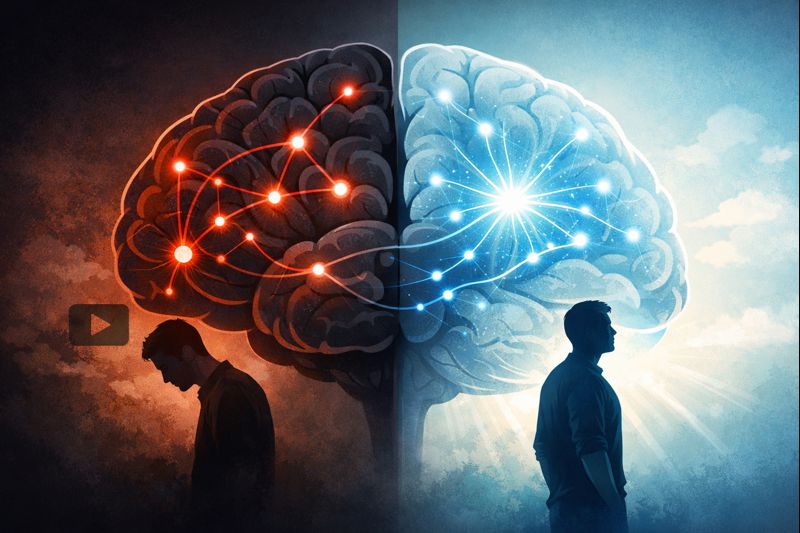
Porn addiction is widely misunderstood. Many believe it is driven by sexual desire or pleasure, but neuroscience tells a very different story. At its core, compulsive pornography use is a dopamine disorder—one that quietly rewires the brain, erodes emotional capacity, and undermines real human connection.
Understanding how this happens is the first step toward lasting freedom.
The Hidden Damage of Porn Addiction
Chronic pornography use does far more than disrupt sexual performance. Research increasingly links excessive porn consumption to erectile dysfunction, reduced libido, delayed climax, and emotional numbness, particularly in men under 40. These effects are not isolated to the bedroom. Over time, users often report diminished joy, flattened emotions, loss of motivation, and strained relationships.
The cycle is self-reinforcing: emotional emptiness drives craving, craving leads to use, and use deepens the emptiness.
Dopamine: Not a Pleasure Chemical, but a Craving Signal
Dopamine is often mislabeled as the “pleasure hormone.” In reality, it is a neurotransmitter responsible for anticipation, motivation, and desire. Dopamine is the brain’s gas pedal—it pushes us toward rewards before pleasure is ever experienced.
Pornography exploits this system with precision.
Rather than delivering satisfaction, it floods the brain with anticipation. The endless novelty, instant access, autoplay features, and escalating content create repeated dopamine spikes that the brain was never designed to handle.
The Coolidge Effect and Why Porn Escalates
The brain is biologically wired to respond strongly to novelty. This phenomenon—known as the Coolidge Effect—has been observed across mammalian species. Interest in a single partner naturally declines over time, but is instantly renewed when a new partner appears.
Pornography weaponizes this mechanism.
With unlimited novelty available at the click of a button, the brain is locked into constant anticipation. Over time, soft content loses its effect, leading users toward more extreme material simply to feel anything at all. This escalation is not moral failure—it is neurological conditioning.
Dopamine Desensitization and Receptor Downregulation
Repeated extreme dopamine spikes cause the brain to protect itself. Dopamine receptors begin to downregulate, meaning fewer receptors are available to receive the signal. The result is profound:
- Cravings intensify
- Pleasure diminishes
- Obsessive thoughts increase
- Real-life intimacy feels dull or unrewarding
This mechanism mirrors what occurs in insulin resistance. When a signal is constantly overstimulated, the body responds by becoming less sensitive to it.
In severe cases, excessive stimulation can even lead to excitotoxicity, where neurons are damaged by constant overactivation.
Why Real Life Can’t Compete With Porn
Real relationships are slow, relational, and unpredictable. Pornography is instant, extreme, and artificially optimized. When the brain becomes conditioned to high-intensity stimulation, everyday experiences feel flat by comparison.
This is why many users feel trapped—not only by behavior, but by imagination and mental imagery that keeps dopamine elevated even in the absence of use.
The Most Effective Way to Reset Dopamine Receptors
The encouraging truth is that dopamine receptors can recover. The brain is remarkably adaptive when given the right conditions.
The most effective—and least discussed—tool for recovery is intentional boredom.
Why Boredom Works
Boredom is the opposite of stimulation. Dopamine thrives on excitement, novelty, and anticipation. When those inputs are removed, dopamine levels gradually normalize.
The key is not passive boredom, but deliberate stillness.
When urges arise, the instinct is to fight them, distract from them, or escape them. Counterintuitively, the most effective response is to do nothing. Sit with the urge. Observe it. Allow it to rise and fall without feeding it.
Each time this happens, the brain relearns that the craving does not need to be obeyed. Over time, urges weaken, thoughts quiet, and emotional balance returns.
Supporting Dopamine Recovery Through Environment and Lifestyle
Recovery accelerates when the environment supports neurological healing:
- Remove triggers: Use content blockers, avoid social media feeds with sexualized content, and keep devices out of vulnerable spaces such as the bedroom.
- Prioritize sleep: Even one additional hour of sleep significantly improves dopamine receptor sensitivity.
- Exercise consistently: Resistance training and regular physical activity restore dopamine balance.
- Reduce refined carbohydrates: Excessive sugar and refined carbs also spike dopamine and reinforce addictive loops.
- Ensure adequate micronutrients: Zinc and magnesium play critical roles in dopamine regulation.
- Increase natural light exposure: Sunlight and time outdoors support neurotransmitter health.
Just as sugar cravings fade when junk food is removed from the home, compulsive behaviors weaken when the environment no longer reinforces them.
The Real Solution Is Less Stimulation, Not More
Porn addiction is not defeated by willpower alone, nor by replacing it with other forms of stimulation. True recovery happens when the nervous system is allowed to recalibrate.
Freedom comes not from chasing stronger experiences, but from quieting the internal noise.
By understanding dopamine, embracing intentional boredom, and aligning daily habits with neurological healing, long-term recovery becomes not only possible—but sustainable.
Final Takeaway
Porn addiction is not about sex. It is about a hijacked reward system. The way out is not through pleasure, distraction, or constant busyness—but through restoring balance to the brain.
When dopamine normalizes, desire stabilizes, clarity returns, and real life becomes rewarding again.
Natural Nighttime Support: A Science-Backed Way to Reduce Stress and Improve Sleep play a critical role in restoring dopamine balance, calming the nervous system, and supporting the brain’s recovery process during addiction healing.
Scientific research published by the National Institutes of Health explains how repeated dopamine overstimulation alters brain reward pathways and how those changes can be reversed through reduced stimulation and behavioral intervention.